In the last few weeks, I have begun to dive headfirst into coding in Python and Generative AI. As I have mentioned in previous posts on my language journey, I find that structure and daily repetition are the best ways for me to learn. I’ve also learned, and I cannot stress this enough, that Reddit is a place to primarily observe and not post unpopular opinions on any topic, especially on topics concerning AI in the hands of the US vs. the PRC.
I often feel like the first few moments of diving into a new subject or exercise have the highest barrier to entry. Whether it’s first going to the gym, or in this case coding – there’s a degree of imposter syndrome (though I don’t know if that’s the best use of the word, because I’m at the starting line). I feel a part of this for anyone is a fear of failure, especially in today’s world where you can look at a reel and see how someone became an “expert” in no time. “Oh, and do you want to buy a class to learn how?” Most, if not all of these people are charlatans, but I digress.
The short of it is that I believe people need to be comfortable with being uncomfortable. Imposter syndrome is a real thing, and it isn’t fun. What compounds this is seeing people who are less capable than yourself in positions of power (please don’t misinterpret this as arrogance – there are plenty of people in positons of power that are deserving and you should be able to recognize that too). As a friend of mine and I say, “The cream rises to the middle.”
A great way to start to develop this growth mindset, is to tell yourself that it’s OK to fail, and you will fail – but you will also learn. Embrace the failures and use them as learning moments, and in time you will actually get excited about the hurdles you face, and ultimately look forward to the feeling of accomplishment when you jump over them – it will be rewarding.
One of the best books I’ve read on this is Mindset, by Dr. Carol Dweck. The book provides thorough research and stories across athletics, industry, music, relationships, and more, with the message that “If you put your mind to it, and are okay with failing, you can become an expert in your field.” Now, there are asterisks in this due to certain genetic traits and natural abilities (LeBron, Phelps, Hawking), but 95% of the population should be able to get to a certain level of expertise.
If you’ve recently had children, or are starting to, I would also suggest reading When You Wonder, a great book on the methodology of Mr. Rogers, which covers a lot of the aforementioned concepts and how to instill this mindset in children.
Now, back to coding….
Even though I have been successful in my life as a sales professional, it’s not all bluster, pomp, and steak dinners. I took my relationships with my customers seriously, and I genuinely cared for their successes – both for their organizations and the sake of their jobs and reputations. For me, this meant having deep technical knowledge (which by far and away a lot of salespeople don’t have), so I could be confident in what I say and recommend, and be able to hold my own in conversations with technical and non-technical people. At the end of the day, it’s easier to be confident in yourself when you understand what you’re talking about.
This thought process is applicable to what I’m attempting to do with coding and GenAI as well.
While I have friends and colleagues who choose a brute force method of development in traditional coding or through the use of Generative AI, I prefer to have a solid foundational knowledge of the given technology. Because of this, I have outlined a routine where I first build code in Python following CodeAcademy, and then I attempt to rebuild from scratch simply using a few sentences in an LLM.
My tools & environments that I have set up so far:
- ChatGPT
- Google Gemini
- GitHub
- Python
- Streamlit
- CodeAcademy
I admit I’m shooting at the hip to a degree, and am leaning on several friends who are developers to help alongside my journey. There are so many fields and disciplines in the development space, I can’t imagine being a master of all (that person is probably lying or just a savant if they are). One of the initial roadblocks I have is simply understanding what the tools are that I need for a Minimal Viable Platform for development. A dozen people asked will probably have a dozen recommendations….
My first development project, if you want to call it that, in CodeAcademy was a simply magic eight-ball-esque script in Python. Being totally green in Python, this took me about 25 minutes to do – I’m sure my developer buddies could do it in 2 minutes.
Then, I wanted to cross reference how this would be built with ChatGPT. The prompt itself took me about two minutes to simply think of the wording, write out the sentences in another minute, run the query, and paste the script into Python and run. There was one error or over-engineered line of code that I simplified. All in all the work was about five minutes.
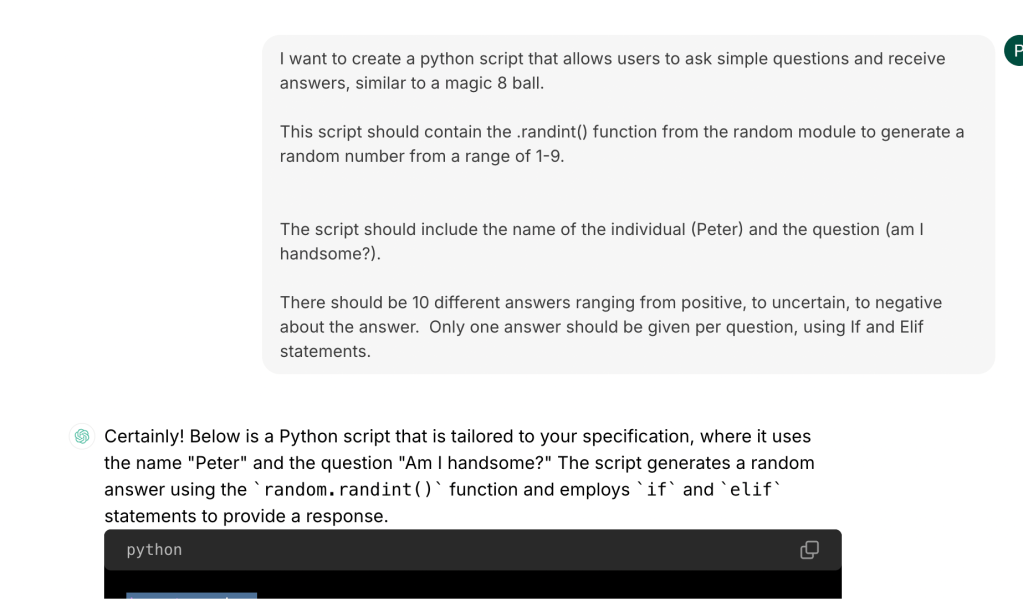
The GenAI script lined up well compared to Python, and the output was more than I hoped!
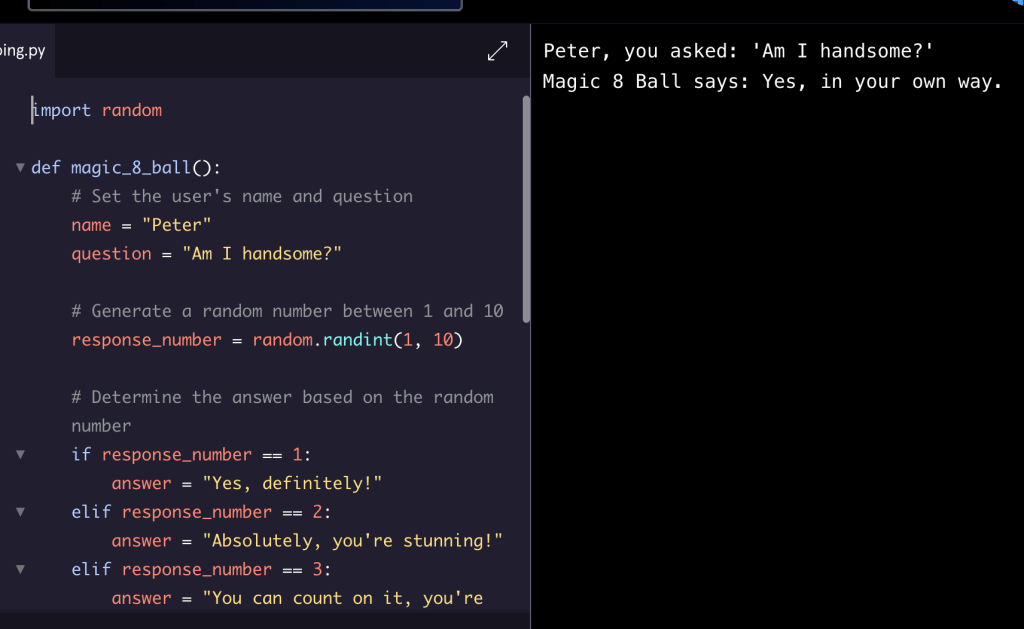
Anyone who knows me can tell you that a founding pillar of my humor is self-deprecation. If it wasn’t evident with all the ‘Roast X City’ videos, it seems that a main feature of ChatGPT is that of a comedian responding to a heckler.
Keep in mind, I am not saying this is anything more than a simple script. This should show the level of approachability of GenAI, even if you have zero experience. I have apps I am starting to build that are both business-oriented and personal, and I will post the results here.
The tiny bit of Python training has helped immensely, as I am starting to understand the basic definitions of coding, which will help with my prompts, and starting to understand coding errors and how to interpret them.
I will also add that I have started to read OpenAI’s articles on how to effectively Code using prompts, and this has already provided great insight and improvements in my prompt structure.
******
There are many schools of thought around what this advent of GenAI is going to actually do. Some developers I’ve spoken to are entirely dismissive of the subject, while others (see Meta) are replacing mid-level engineers as we speak (we’ll also see how that goes over this next year, or if Zuck is simply blustering and using this as an excuse to decrease OpEx and over-burden his current developers), and some think in a few years, if not already, we will enter an age of dumb coders, worthless without the assistance of AI.
I’m bullish on GenAI. I’m not saying it’s going to replace coders – although I imagine it doing a lot of the work, with fewer ‘master coders’ overseeing the work – but I think it’s ultimately great for people who want to get a proof of concept out there, see what they want build is viable from a high level, and then partner with a true developer to make a clean product that is both marketable and scalable.


Leave a Reply